
|
Property is Libertyby Hogeye Bill |
Jan 25, 2026
In wickedness the haughty man and the weakling meet. But they misunderstand one another. - Friedrich Nietzsche
Let's start with some definitions so we don't talk past each other. This is particularly important when discussing property, since socialists and capitalists have quite different definitions of some key terms. I will use Peaceful Revolutionary's article Property Rights: Personal vs Public vs Private Property vs Propertarians as my socialist source since it is well-written, understandable, and concise.
property -
- a social convention or norm describing who should have jurisdiction (ownership) over the disposition and use of scarce resources [property system]
- an owned resource; the object of ownership
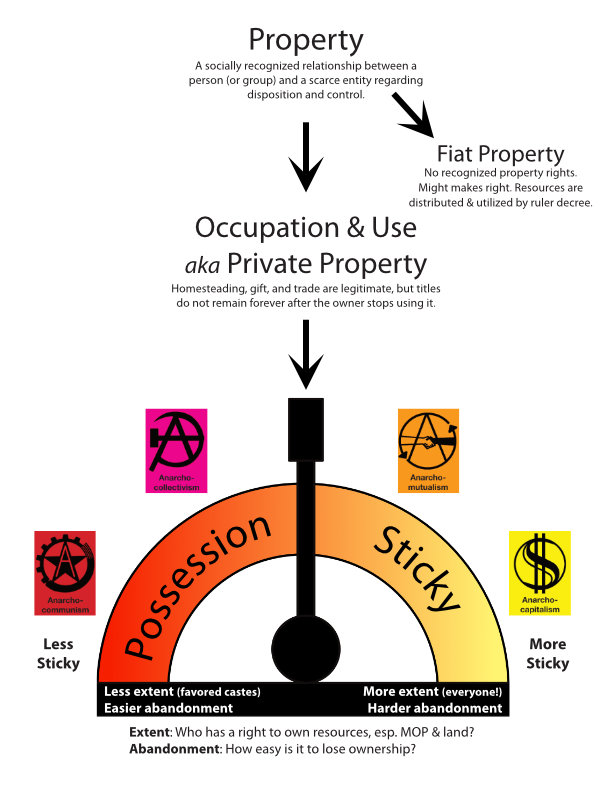
The purpose of property is to solve the scarcity issue peacefully. Everyone supports property. Capitalists favor property of the sticky type, with strong abandonment conditions favoring current owners. Socialists tend to favor property of the possession type, with weak abandonment conditions thereby favoring squatters and disfavoring absentee owners. Some socialists favor collective property, where only certain "blessed" castes can own certain resources. Socialists and capitalists both favor property as such, but prefer different property norms. No one is really anti-property except a few caveman primitivists and criminally insane psychopaths.
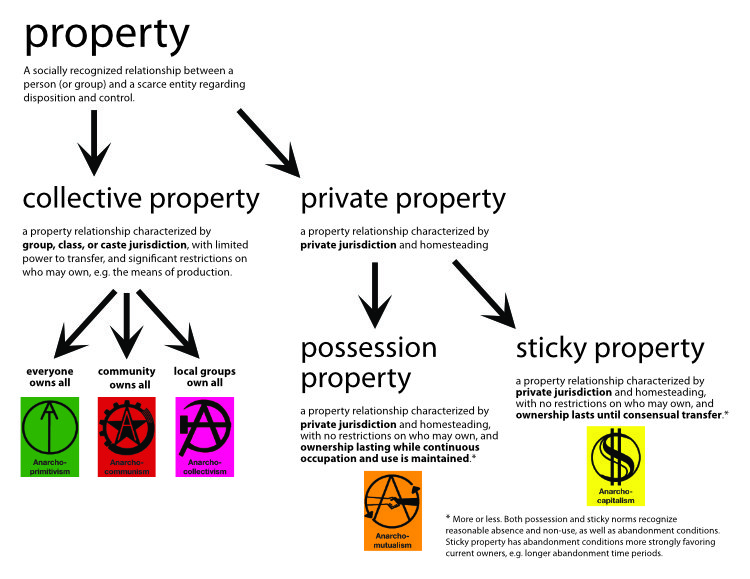
Capitalists tend to classify property in two distinct ways. The first categorization is by type of property norm, divided into collective property, possession property, and sticky property. This is the ethical dimension, which includes the Entitlement Theory of Distributive Justice. The second categorization looks at the current use of a good - whether it is a consumer good, a capital good, or raw material for creating a good. This second categorization is not ethical, but practical for planning production.
Socialists tend to classify property first by current use, and then base property norms on that current use. Thus, a toothbrush or car or computer may be a consumer good sometimes and a capital good at other times, depending on use.
Peaceful Revolutionary: "Public property is what belongs to everyone."
But ownership involves disposition and control over a resource. Public property involves no such control, but is merely a right to use a resource without a right to exclude others. (This almost always leads to tragedy of the commons unless there is a "management group" to own it.) "Public property" seems a misnomer - or worse, an Orwellian evasion. This should be called common usage rights, or some such. The term "public property" is particularly misleading since it is frequently used by statists to mean "government property.""
PR: "For most of human history all land was public or common, it had no walls or borders."
This is the default historical assumption of many socialists, but not the assumption of anarcho-capitalists. We believe that before anyone has actually used the scarce resource in question, its status is unowned. It is not property yet. It becomes property through the homesteading principle, the idea that one gains ownership by "mixing one's labor" with the previously unowned resource. That is, one must actually use the resource sufficiently to become owner. The determination of what is "sufficient" is left to local consensus.
I can see no common ground or way to resolve these two incompatible moral intuitions:
Capitalist: Resources by default are unowned until someone uses them.
Socialist: Resources by default are owned by everyone (living or to be born).
For most of human history, the population density of humans was about the same as that of bears. Most land was used sporadically for hunting and foraging, and was not scarce, that is, not rivalrous in the economic sense. Thus, land was not yet scarce enough to be deemed property. But tents and weapons and food were generally private property even in hunter-gatherer days. Cultivated land in villages was private property, too. Early anthropologists like Kropotkin mistakenly believed that hunter-gathers held property in common, but that notion has been thoroughly debunked. Most primitive tribes had property held by households and individuals, not village collectives. As populations became more dense due to the agricultural revolution, cultivatable land became scarce and property conventions evolved. Property provided the solution to the scarcity problem: How to resolve resource disputes peacefully. You can have property norms, or people attacking and killing each other for resources. Man prospered because he found a peaceful alternative to bashing in his neighbor's (or enemy's) skull to gain resources - property!
Personal property is what a person has and uses for themselves and the people close to them.
We agree. Personal property is a type of private property to ancaps and ansocs alike. One may control and dispose of your toothbrush, and exclude others from using it. Then again, one could rent out your toothbrush which would make it a capital good rather than personal property.
But wait. Some socialists seem to think that personal property is not private property, even though it satisfies the excludability condition. Why is that? Proudhon ridiculed this notion of an artificial separation of personal and production goods. The words the socialists are looking for is "consumer goods" and "capital goods." What socialists call "personal property" is precisely what capitalists call "consumer goods."
One flaw in Peaceful Revolutionist's article is that it confuses two quite different causes of feudalism and wealth inequality. PR apparently thinks he's attacking capitalism, but in actuality he is attacking statism. For example,
PR: The custom among my Celtic ancestors was that they could keep as much land as they could plough in a day. This continued for a few thousand years until kings sprang up and gave ownership of that land to lords.
This is a fine attack on kings and rulers and land thieves, but says nothing about private property. My anarcho-capitalist interpretation of feudalism is that, yes, kings and underling lords and barons took control by brute force when property rights could only be held by the ruling elites. Due to famines, then the rise of craftsmen and artisans, then later the rise of industrialism, the right of property was expanded to the masses, the common man. The progress of mankind is largely the result of expansion of property rights to the people.
Another example of (rightly) criticizing statism but (wrongly) thinking he's criticizing capitalism is this:
PR: The lords … realized they could get these workers by kicking the peasants off the land, because the lords had a piece of paper saying they owned that land. Past kings told their ancestors this …
Yes, we all agree those kings and lords were evil and did control land they gained by conquest. Were they legitimate owners by the Entitlement Theory? Of course not! We need a term for pseudo-property, for land unjustly taken by conquest or theft by rulers. We have one: fief. We anarcho-capitalists know the difference between fief and property. Statist anti-immigration types do not know the difference, and neither do most socialists, statist or libertarian. Generalizing fief, we can talk about ruler decreed property, even though technically it is not valid property per the Entitlement Theory.
PR: This is what makes private property a different thing from personal property entirely. ... It excludes the many for the privilege of the few. When we privatise something we make it profit-producing.
I've already discussed how this is a non-distinction, since personal property does exclude others. (Don't use my toothbrush! I exclude you.) And a toothbrush can generate profit. (Okay, you can use my toothbrush for a dollar.) When I do programming on my computer for others, it is a capital good, but when I watch porn it is a personal good. If I am programming while watching porn, it is both. Similarly for an Uber driver's car.
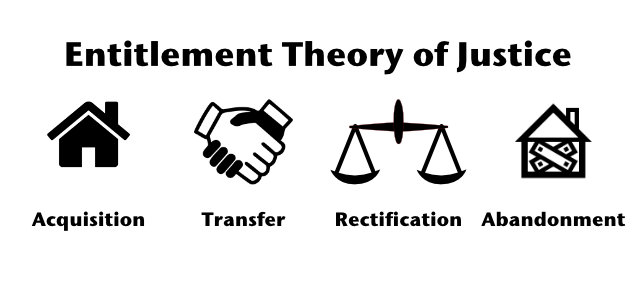
PR has a reasonable flowchart diagram of the "Property Rights Model" (other than his false assumption that only a State can enforce property rights.) Property rights are legitimate through (1) original acquisition or (2) voluntary trade or gift. That is the Entitlement Theory in a nutshell, although Robert Nozick adds (3) rectification for disputes, and I have added (4) abandonment criteria.
PR: Whereas personal property is a relationship between people and things, private property is a relationship between people and people.
This is obviously false. Even personal property involves a relationship between people. You should not steal my toothbrush! Personal property has the same norm as any other private property - that others should not steal it. Bottom line: Property is about resource usage norms. Norms involve agreements between people not to steal others' stuff, a social agreement about what is mine and what is thine.
PR: This is why Pierre-Joseph Proudhon made his famous statement that ‘property is theft'.
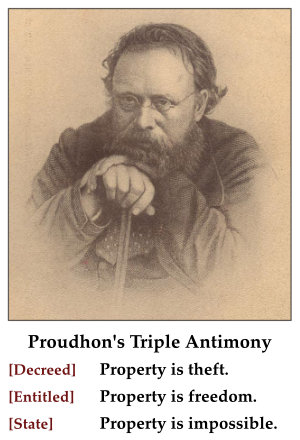
I'm afraid that most socialists who quote Proudhon about this have never read Proudon's "What is Property?." Or they are stupidly repeating a bumper-sticker quote they like. Or perhaps they grossly misunderstood what Proudhon was saying. I have read Proudhon, and know what definitions he was using and the examples he gave. So for any misguided anarcho-socialists, here are Proudhon's key definitions stated in modern language.
Proudhon's term - modern termproperty - statist decreed pseudo-property
possession - natural law entitlement theory private property
For anyone who has actually read What is Property? this is obvious. Every single example of "property" in the treatise is decreed by rulers, a king, a State. His examples are from Roman Law and feudal legal systems. On the other hand, every single example of "possession" is pure anarcho-capitalism. This isn't a new observation; Benjamin Tucker, the first translator of Proudhon into English, also interpreted Proudhon in an anarcho-capitalist pro-private property manner.
PR: Private property created a system for perpetuating unearned privilege by passing wealth and property from one generation to the next.
The "unearned privilege" part is statist, and not a knock on private property or capitalism. In fact, it is quite clear that libertarian capitalism devolves wealth to the masses. It is statism and its cartelization and regulation of markets that causes the concentration of wealth. We ancaps totally agree with ansocs that fascism (statist capitalism) is evil. Do ansocs agree with ancaps that statist socialism is also evil? Some do; many do not - which shows that such people are anidiotist* rather than anarchist.
The weakest part of PR's article is the Propertarians section, since it is nothing but a straw man claim.
PR: One particular idealogical group considers private property to be the source of all freedom …
No anarcho-capitalist ever has said this. It amounts to total ignorance of what libertarian capitalists actually believe, like someone believing their own propaganda slogans. I am a propertarian, and I believe that liberty is primary. That means the rights of man - life, liberty, and property. I would say life and libery is primary (its hard to separate those two) and that property is the way we anchor life and liberty to reality. If you can't own food or tools, your life will be short and your liberty non-existent!
We capitalists don't evade reality: Inequality in a voluntary society is natural and good. Inequality can result from differences in intelligence, talent, location, education, heredity, environment, and luck. We anarchists are fine with those natural differences. The inequalities we oppose are the ones resulting from rulership. Anarcho-socialists are free to create their own "equal" communities. Panarchy! Everyone can choose which property norms they prefer, and even change and experiment by visiting enclaves with other norms. The foreign policy of anarchy is panarchy. Seek the best of all possible worlds!
PR: Propertarians believe that property is so important that violence against property is the worst of all crimes.
Laughable. What a crazy straw man! No ancap ever said that. I, and all the ancaps I know, would say that violence against people is worst. But then again, since we capitalists believe that every person owns himself (self-ownership) PR's assertion is technically true (although misleading to most people.)
PR: Propertarians often justify their claims through John Locke's notions of ‘improvement,' arguing that land becomes rightfully owned when someone improves it through labor.
Right. The precise amount of labor needed is decided by local consensus, i.e. by local property norms.
PR: Yet this philosophy conveniently ignores whose labour typically performs these improvements.
No it doesn't. But socialists conveniently ignore that employees have voluntarily traded their labor time for cash rather than ownership of whatever they are working on. This would be obvious, except that PR again conjures up kings and lords during feudalism as his example rather than employers hiring free men. ("It wasn't lords who cleared forests, built irrigation systems, or harvested crops.")
PR: Although ‘Libertarian' Murray Rothbard stated that ‘no man or group of men may aggress against the person or property of anyone else, the indigenous inhabitants were conspicuously forgotten in the question of land ownership.
PR obviously hasn't read enough Rothbard. True, Rothbard held the Non-Aggression Principle, but he applied it to everyone, including Indians.
Generally we may say that the native American Indians regarded the newcomers with a mixture of brotherly kindness and eagerness to make contact with the world outside; this, however, was countered by hostility based on the well-founded fear that the colonists were out to seize their lands. ... Tribal law often decreed land ownership over large tracts of even unused acreage. Still, however, this land inequity provided no excuse for the physical dispersion of individual Indians from their homes and from land actually used, let alone the plundering of their crops and the slaughtering of the Indian people.
- Rothbard, Relations with the Indians, Conceived in Liberty Vol. 1, Ch. 8
We ancaps believe that Native Americans did have valid property rights, which were grossly violated by the US government, its soldiers, etc. The notion that ancaps don't respect the property rights of aboriginal peoples is ridiculous.
PR: This selective application reveals the true purpose of these principles: not to protect all people from aggression, but to protect the existing distribution of land, wealth and power from redistribution.
Again, PR gives a very good critique of statists, but not libertarians. The same old bait and switch. Needless to say, we ancaps agree totally with his critique of statists. To anarcho-capitalists, the Non-Aggression Principle applies in spades to the State. We oppose the current statist looting and redistribution of wealth. It seems disingenuous to try to criticize anarchists for things the scumbag ruling elites do.
Libertarian capitalism, also known as anarcho-capitalism, could well be called propertarianism. It is the belief that the best way to solve the scarcity problem without violence is to have property norms. Such norms should be decided by local consensus, either by emergent arbitration services or voting in voluntary organizations. The NAP is a high-level principle that depends on some underlying property norm. Anarchy allows diversity and pluralism in voluntary norms. Property is liberty!
* anidiotist - anti-propertarian, from Greek words an meaning without, and idiotis meaning property. This is analogous to the etymology of "anarchism."